On this page
Halo hair extensions are removable added hair supported by a fine line beneath your own hair. They appeal to people who want extra length or fullness without fitting a row of clips or keeping adhesive attachments installed. The important checks are the exact support design, a stable position and enough natural hair to cover the line and base.
The word halo is used for more than one construction in the wider market. Ruiteng describes its Halo product with individual strand clear-line attachments, while its Flip-in Weft uses a single transparent line supporting one weft. Check the actual product rather than assuming two similar names mean the same thing.
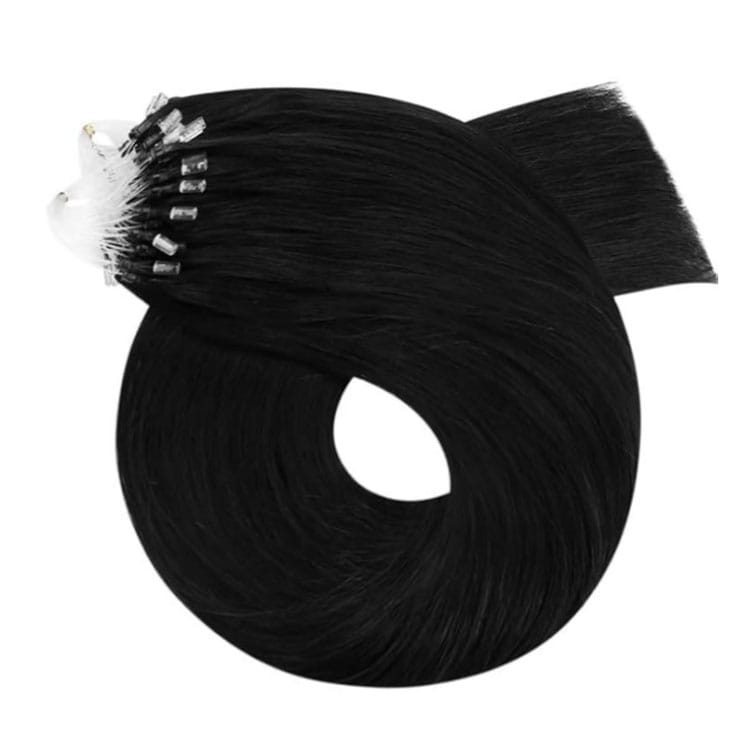
What should you see when the product is laid flat?
Look for the hair, its top edge and the line arrangement. The support is a working component rather than packaging. You need to understand how it is meant to sit before trying to position the hair on your head.
The Halo Hair Extensions page describes human hair worn beneath natural hair without clips or glue. The separate Flip-in Weft page describes one weft carried by a single transparent line. Comparing these descriptions helps you ask a precise question about the version you are considering.
If you have a sample, handle the line gently and follow the supplied fitting directions. Do not stretch, knot or alter it to imitate a tutorial for another design. A support line that looks unobtrusive still needs to be the correct shape and condition for the product.
Is line support the same as a row of clips?
The two systems hold added hair in different ways. Clip-ins distribute attachment through several clips on pieces of varying widths. A wire-supported design relies on its line arrangement and the intended seating of the hair. Each has its own fitting and concealment checks.
| Check | Wire-supported piece | Clip-in pieces |
|---|---|---|
| Main support to understand | Line and the piece it supports | Clips along individual bases |
| Trial-fit priority | Position, stability and line coverage | Piece placement and clip coverage |
| Changing the amount | Depends on the exact product arrangement | Often choose among separate pieces |
| Storage priority | Protect the support from pulling or sharp bends | Close clips and protect the bases |
| Style limitation to test | Hair lifting away from the line or base | Hair lifting away from the clip positions |
There is no need to treat one method as the universal beginner choice. Think about which arrangement you can fit comfortably and how often you want to change the amount. If both are possible, a supervised trial can be more useful than comparing marketing terms.
Can your own hair conceal the support?
The natural hair above the added piece forms the visible top layer. If that layer is sparse or very short, the line or base may remain visible. The fact that a product has no clips does not create more covering hair.
Check the result at the crown, sides and back with the hair resting naturally. Turn your head and look down. A line can appear when covering hair separates, even if it was invisible in the mirror from straight ahead.
Fine hair and low density are different concerns. Fine strands can still form a useful covering layer if there are enough of them. Sparse areas may be harder to conceal regardless of strand thickness. Ask a stylist for an assessment if you are uncertain rather than choosing from a photograph of someone else’s hair.
What does a good practice fitting tell you?
It tells you whether the piece sits where the instructions intend, whether it shifts during ordinary movement and whether the lengths connect with your own hair. It should also tell you how easily you can remove it without catching the support.
Try the product at home with time to inspect it. Set aside the dramatic event hairstyle for the first trial. A simple loose style makes it easier to see a gap, a bulky area or a visible line before extra styling disguises those details.
If the piece slides or feels unstable, take it out and check the fitting instructions. Avoid solving movement by pulling the line tighter without guidance. A change that hides the line can also change how the piece sits, so evaluate the complete fit after any permitted adjustment.
Will it match your haircut as well as your color?
Removable hair can match a shade perfectly and still look separate if the lengths do not blend. A blunt haircut may form a visible ledge above the extension hair. Shorter face-framing sections may also need attention where they meet the added lengths.
Take a photograph from the back with both sets of hair resting naturally. Look for a believable outline rather than only overall length. If you can see two distinct shapes, ask whether placement, quantity or a professional trim would help.
Compare the usual texture too. If your own hair has a wave that returns after washing, a very sleek extension piece may need styling each time to blend. A finish closer to your normal hair can reduce the work required for an ordinary day.
How should you compare shade in a removable piece?
Use indirect daylight and compare the added hair against your own mid-lengths and ends. Those are the areas likely to sit side by side. A root match can be misleading if your hair gets lighter through the lengths.
Look for tone as well as lightness. A cool brown and a warm brown can be similarly dark but separate clearly when laid together. If your hair contains highlights, ask how much color variation is present in the piece rather than assuming a solid shade will blend everywhere.
Ruiteng’s color chart is a useful reference for the discussion. A physical swatch is still more informative than a filtered photograph. Include a rear view of your own hair if you ask for matching help, since the front can have a different level of brightness.
What changes when you want to wear your hair up?
A removable wire-supported format is designed to sit in a particular arrangement beneath your own hair. Lifting that hair into a high ponytail can expose or move the base. Do not assume a piece that works beautifully in a loose style supports every updo.
Try the intended hairstyle during the practice session and check from behind. A low, loose arrangement may behave differently from a tight high style. Follow the maker’s guidance and avoid forcing the support into an unfamiliar angle to keep it hidden.
If an updo is your main goal, show the style before choosing a format. A stylist may suggest another removable option or a different arrangement. It is easier to select hair for the hairstyle than to buy first and discover that the support sits in the area you need to expose.
What should happen after each wear?
Keep necklaces, zips and other objects away from the support when taking the piece out. If something has caught, free it before lifting the hair away rather than pulling the line through the snag.
Remove the hair before sleeping, following the product instructions. Ruiteng specifically advises removal of its Halo format before bed to reduce abrasion of the support lines. Keep the line from being pulled while you lift the hair away.
Detangle the lengths with the support protected. Start with the ends, work in small sections and avoid dragging a tool through the line attachment area. If washing is needed, follow the directions for the exact removable product and let it dry completely before storage.
Store the hair so the line is not sharply folded or stretched around another object. A case is useful only if there is enough room to lay the piece safely inside it. Keep the product details nearby so you can identify the line design and shade if you need help later.
Which small problem should make you pause?
A damaged line, an unfamiliar knot in the support or a piece that no longer sits as intended deserves a check before the next wear. Do not keep pulling at the support to see whether it will return to shape. Ask about replacement or adjustment instructions for the actual component.
If the fit is uncomfortable, remove the piece and reassess it. A hidden support is only useful when the overall result is wearable. General background on the different extension categories is available in Wikipedia’s hair integration overview.
For product advice, describe the hairstyle you want, your current length and whether you are considering the Halo or single-line Flip-in construction. Use the form below to ask for the support and shade details that will help you make that choice.
Frequently asked questions
Are halo and flip-in names interchangeable?
Not reliably. The Ruiteng listings describe different line arrangements for the two products. Compare the actual base and support information. A tutorial for a single-line piece may not be appropriate for another clear-line construction.
Is a transparent line always invisible?
No. Visibility depends on the line, the fit, lighting and covering hair. Check the crown and sides during movement. A transparent material does not remove the need for enough natural hair over the support.
Can I sleep in the Halo product?
The product description advises taking it out before sleeping to reduce abrasion of the lines. Follow those instructions and store the removed hair carefully. A removable format works best when its support is protected between wears.
Can the human hair be curled or straightened?
The listed hair supports heat styling, but the line is a separate component. Keep direct tool contact away from it and follow the product guidance. Test a discreet section of the hair before applying a new styling method throughout.
What should I check if the piece keeps moving?
Stop and revisit the fitting instructions, the condition of the line and whether the product sits correctly for your hair. Ask for professional or product-specific advice. Adding tension without understanding the fit is not a dependable correction.